If you have been watching the shelves at your local dispensary and noticed a name that sounds more like seafood than a cultivar, there is a reason for that.
The blue lobster strain tends to catch patients off guard before it earns their full attention, and once it does, it rarely lets go. At Hamilton’s Bud and Bloom, we have seen this cultivar create real curiosity among patients who want something with genuine character: a bold terpene profile, visually striking buds, and effects that feel intentional rather than accidental.
Whether you are reaching for it for the first time or trying to understand exactly what makes it stand out, this guide covers the angles that most strain breakdowns skip entirely.
What the Blue Lobster Strain Actually Descends From and Why That Lineage Matters
Most strain guides will list the parents and move on. But when you understand why the Blue Lobster weed strain was bred the way it was, the experience starts to make a lot more sense.
Blue Lobster is widely recognized as a cross between Blue Dream and East Coast Sour Diesel. That pairing is not random.
Blue Dream brings structural balance, which is a smooth sativa-leaning base with calming body undertones and a fruit-forward terpene edge. East Coast Sour Diesel layers in the sharp, fuel-driven cerebral intensity that long-time cannabis patients either crave or treat with respect.
What that genetic combination gives you is a cultivar that does not simply lean one direction. You get a mental lift that arrives cleanly and a physical effect that supports rather than competes with it.
The Visual Profile That Makes This Cultivar Immediately Recognizable on the Shelf
Before you ever break open a nug, the appearance of Blue Lobster cannabis tells you what to expect.
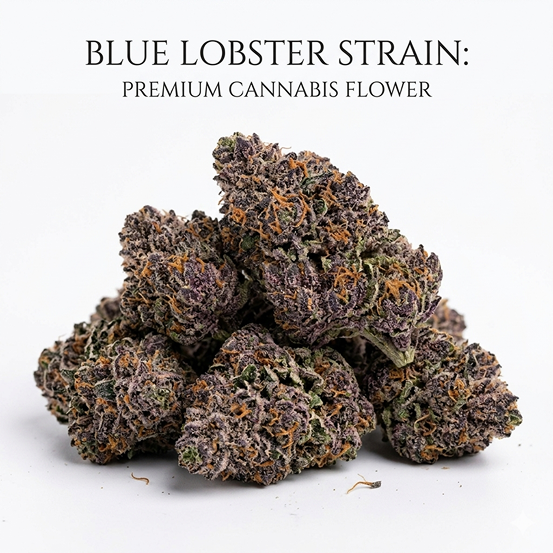
The buds are dense and elongated, with a structure that leans more toward the indica side of its hybrid makeup. What catches most patients immediately is the coloration.
You can expect:
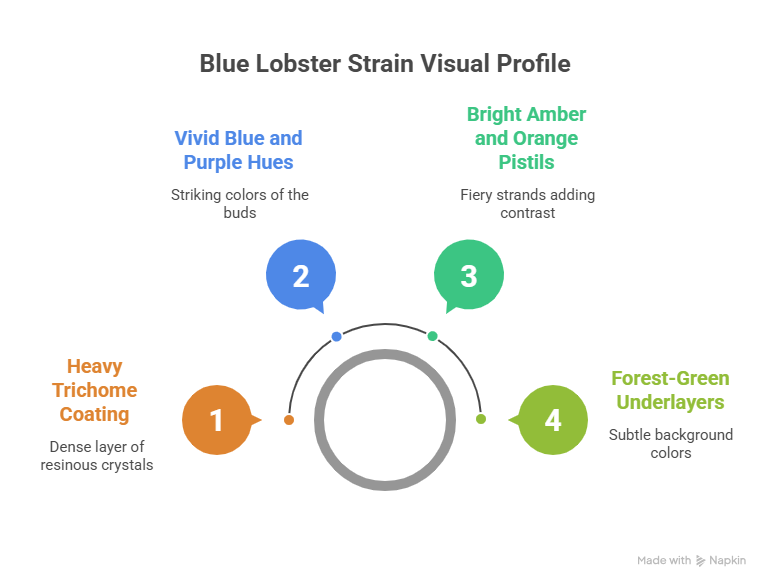
- Vivid blue and purple hues that are woven through the calyxes, especially on properly cured, cold-grown cuts.
- Bright amber and orange pistils that create a strong contrast against the cooler tones.
- A heavy trichome coating that gives the surface a frosty, almost reflective appearance under light.
- Forest-green underlayers that support the overall look without dulling the visual drama.
A Terpene-by-Terpene Breakdown of What You Are Actually Smelling and Tasting
This is where most strain guides tend to flatten the experience into a single adjective, “earthy” or “sweet,” without giving you much to work with. The Blue Lobster weed strain deserves more precision than that.
|
Terpene |
Aroma Contribution |
Effect Influence |
|
Myrcene |
Musky, herbal, tropical undertones |
Relaxation, body softness, mild sedation in larger doses |
|
Caryophyllene |
Spicy, peppery, fuel edge |
Anti-inflammatory interaction, stress buffering |
|
Pinene |
Sharp pine, fresh air quality |
Mental alertness, memory support, and airway clarity |
|
Limonene |
Bright citrus, lemon zest |
Mood elevation, anxiety reduction |
How the Blue Lobster Strain Actually Hits Across Different Types of Patients
The effects conversation is where this cultivar earns its reputation and where it also gets misread by patients who expect a straightforward experience.
THC content on Blue Lobster cannabis typically ranges between 20% and 26%, with some premium cuts testing higher. That range puts it in solidly potent territory without crossing into overwhelming territory for most experienced patients.
Here is what the effect arc generally looks like:
Within the first 5 to 10 minutes, you will likely feel a cerebral shift, a brightening of focus and mood that does not feel scattered or anxious. This is the Blue Dream side doing its work cleanly.
Between 15 and 30 minutes in, the physical layer starts to emerge. Your body begins to soften without dragging your mental engagement down with it. This middle phase is where you find your sweet spot, mentally present and physically at ease.
In the latter portion of your session, the Myrcene-driven relaxation becomes more prominent. Whether this translates to couch-lock depends heavily on your dosage and tolerance, but with moderate intake, most patients report staying functional rather than sedated.
What this means practically:
- It works well for afternoon use when you want to decompress without fully switching off.
- It can support creative work that benefits from a relaxed, unhurried mental state.
- Patients who manage stress, mild anxiety, or physical tension tend to gravitate toward it repeatedly.
- It is generally not the cultivar you reach for when you need sharp focus or high-output productivity.
Conclusion
The blue lobster strain is a genuinely layered cultivar with real genetic depth, a terpene profile that rewards attention, and effects that adapt to your pace.
Whether you are drawn to its striking visual appeal or the balanced hybrid effects that have made it a consistent patient favorite, there is a good reason this cultivar holds its ground on premium shelves.
At Hamilton’s Bud and Bloom, we are here to help you find the right cultivar for the right moment, not just hand you something popular. If Blue Lobster is on your list, come in and talk to our budtenders.
We will make sure you walk out with exactly what your session calls for. Stop by our Broken Arrow dispensary or browse our live menu today. Your next favorite cultivar might already be waiting for you!
FAQs
1. What kind of high does the blue lobster weed strain produce?
The Blue Lobster weed strain delivers an uplifting cerebral onset followed by gradual physical relaxation. It is generally not overwhelming at moderate doses.
2. Is Blue Lobster cannabis indica- or sativa-dominant?
Blue Lobster cannabis leans slightly toward the sativa side of its hybrid makeup due to its Blue Dream and East Coast Sour Diesel lineage, but the physical relaxation from Myrcene-dominant terpenes makes it a true balanced hybrid.
3. What does the Blue Lobster weed strain smell like?
Expect a sharp diesel opening from its Sour Diesel genetics, softened by tropical and musky sweetness from Myrcene, with a clean pine finish from Pinene.
4. When is the best time of day to use the Blue Lobster strain?
The blue lobster weed strain is best suited for afternoon or early evening use. Its balance of mental clarity and physical relaxation makes it well-matched to that transitional part of the day when you want to unwind without completely shutting down.