

Medical marijuana benefits have matured very much in recent years. What was once largely anecdotal is now supported by a growing body of research, clinical observation, and patient-reported outcomes across a range of conditions. But understanding which benefits apply to your specific situation and how to access them effectively through the right products is where most general guides fall short.
This one is built around what we actually hear from patients at Hamilton’s Bud and Bloom and what the evidence behind those experiences looks like.
How the Endocannabinoid System Determines Which Benefits You Experience
Most medical marijuana content jumps straight to a list of conditions cannabis can help with. What gets skipped is the underlying mechanism that explains why it helps, which is the endocannabinoid system.
Your body already produces cannabinoid-like compounds that regulate processes including pain signaling, inflammation, mood, appetite, and sleep. Cannabis works by interacting with the same receptor network that those compounds use, primarily CB1 receptors that are present in the brain and nervous system, and CB2 receptors that are in the immune system and peripheral tissues.
Why does this matter practically? Because your individual endocannabinoid system is as unique as your fingerprints.
Two patients with the same diagnosis consuming the same product may have noticeably different responses. That variability is not a flaw in cannabis as medicine. It is an expected result of individual biology, which is exactly why starting low, tracking your response, and adjusting incrementally produces better outcomes than simply following someone else’s dosage recommendation.
The Medical Marijuana Benefits That Patients at Hamilton’s Report Most Frequently
Chronic Pain and Inflammation Management
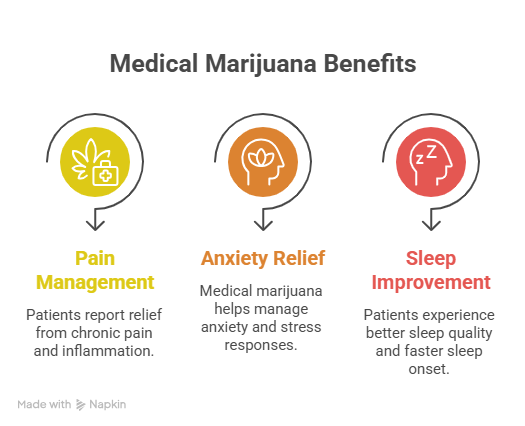
Pain relief is the most commonly reported reason patients in Oklahoma pursue a medical marijuana card. The research supporting this is stronger than for most other applications.
Cannabinoids, particularly THC and CBD working together, have demonstrated measurable effects on pain signaling and inflammation in studies covering neuropathic pain, arthritis, cancer-related pain, and muscle-spasm disorders.
The format you choose affects how targeted and how long-lasting the relief is. Inhalation works quickly but dissipates within a few hours. Edibles take longer to arrive but can provide sustained relief across four to eight hours.
For localized pain in a specific joint or muscle group, topicals offer site-specific relief without any psychoactive effect, which makes them useful during the day when cognitive clarity matters.
Anxiety and Stress Response
Anxiety is the second most-reported qualifying condition among Oklahoma medical marijuana patients. The relationship between cannabis and anxiety is nuanced in a way that most content oversimplifies.
THC at high doses can increase anxiety in sensitive individuals. CBD tends to produce calming effects without psychoactivity. Indica-leaning cultivars with myrcene and caryophyllene terpenes are generally better suited for anxiety relief than high-THC sativa-leaning options.
Matching the right product to the right anxiety presentation is where budtender consultation becomes genuinely valuable. Generalized anxiety, social anxiety, PTSD-related hyperarousal, and situational stress each respond somewhat differently to the same cannabinoid profiles.
Sleep Quality and Sleep Onset
Sleep dysfunction affects a significant portion of medical cannabis patients, either as a primary condition or as a secondary effect of chronic pain or anxiety.
Cannabis supports sleep primarily through two mechanisms: reducing the time it usually takes to fall asleep and reducing REM sleep frequency, which can benefit patients who experience trauma-related nightmares or disrupted REM patterns.
Indica-leaning cultivars with elevated myrcene content are consistently associated with these outcomes. CBN, a cannabinoid found in aged cannabis, is increasingly included in sleep-focused edible formulations and may enhance sedative effects when combined with THC.
The Medical Marijuana Benefits That Are Less Discussed but Equally Important
|
Condition |
Relevant Cannabinoids and Terpenes |
Best Formats |
|
Appetite stimulation |
THC, limonene |
Flower, edibles |
|
Nausea relief |
THC, CBD, THCA |
Tinctures, vaporized flower |
|
Muscle spasm reduction |
CBD, myrcene, caryophyllene |
Topicals, edibles |
|
Mood regulation |
THC, CBD, limonene, linalool |
Flower, tinctures |
|
Nerve pain |
CBD, THC, beta-caryophyllene |
Edibles, topicals |
Appetite stimulation is particularly significant for patients undergoing chemotherapy, those managing eating disorders clinically, or patients with conditions that suppress appetite as a symptom.
The THC-driven increase in appetite is one of the most consistent and well-documented effects in cannabis research.
Why Format Selection Is a Core Part of Accessing These Benefits
Understanding that cannabis can help is only half the equation. Understanding which format delivers that help most effectively for your specific need is what turns potential into actual relief.
Vaporized flower delivers the broadest terpene spectrum quickly. Edibles provide sustained systemic effects. Topicals address localized symptoms without psychoactivity. Tinctures offer a middle ground with a faster onset than a standard edible and more precise dosing than flower.
Our online shop gives you a full view of our current menu, organized by category.
To Sum Up
The medical marijuana benefits available to patients are broader and better-supported than most public discourse reflects.
From chronic pain and inflammation to anxiety, sleep, nausea, and mood regulation, cannabis works through a biological system that already exists in your body to support conditions that conventional medicine often treats incompletely.
At Hamilton’s Bud and Bloom, we help patients translate that potential into actual results through informed product selection and genuine consultation. Check our current deals for the best value on your next purchase, and stop by to let our team help you find what your body has been asking for.
FAQs
How long does it take for medical marijuana benefits to work for chronic pain?
Smoked or vaporized cannabis produces effects within minutes. Edibles take 60 to 120 minutes but provide longer-lasting relief that often makes them more practical for sustained pain management throughout the day.
How long does it take for medical marijuana benefits to work for chronic pain?
It can occur in some patients, particularly at high THC doses. Indica-leaning cultivars with calming terpene profiles are generally better suited for anxiety relief than high-THC sativa-leaning options.
What is CBN, and how does it affect sleep?
CBN is a cannabinoid that forms as THC ages. It is increasingly used in sleep-focused edible formulations and may enhance sedative effects when combined with THC, making it useful for patients with sleep onset difficulties.
Are topicals effective for deep joint pain?
Standard topicals provide surface-level localized relief. Transdermal products penetrate more deeply and can reach bloodstream levels, which makes them more effective for joint pain that sits below the skin surface.
How do I know which medical marijuana product is right for my condition?
Our experienced budtender can help you narrow down which products are most likely to support your specific condition and lifestyle.