
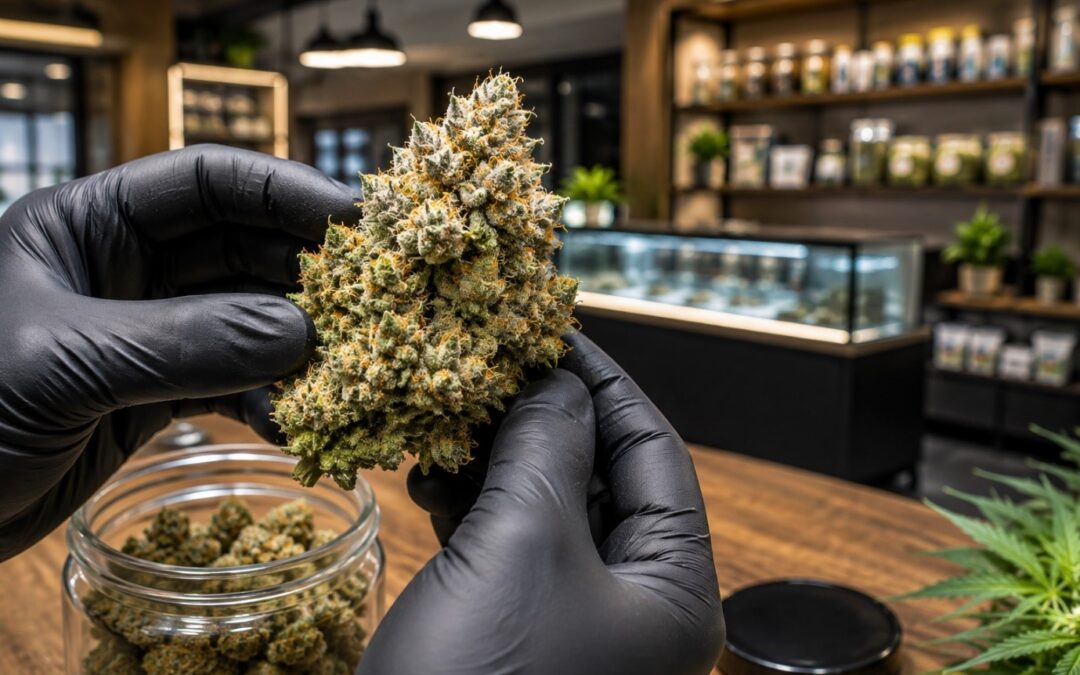
Most patients pick up a jar, look at it through the glass, and make a purchase without knowing what they are evaluating. With the Snowball strain, that habit costs you more than with most cultivars. This is a flower where the quality signals are specific, visible, and easy to read once you know what you are looking for.
At Hamilton’s Bud and Bloom, we evaluate every batch before it reaches the shelf, but we also want you to understand exactly what we are checking and why.
What The White Parent Tells You About the Trichome Structure You Should See
Ethos Genetics bred Snowball by crossing The White with Chem 4 OG. Most people know The White for its resin production, but the specific mechanism matters for evaluating what you buy.
The White is a clone-only cultivar famous for producing blanket-like trichome coverage so dense it masks the underlying bud color entirely. It carries almost no natural aroma of its own, which means every aromatic quality in Snowball’s profile comes from the Chem 4 OG side of the cross.
That genetic split creates a very specific visual standard. Quality Snowball buds should appear almost opaque white, with the underlying light-green and occasional violet hues completely obscured by trichome coverage.
If you can see the base color of the flower clearly, the trichome density did not reach what this cultivar is capable of.
What Capitate-Stalked Trichomes Look Like and Why They Matter
The trichomes in a well-grown batch of this cultivar are capitate-stalked, meaning each one has a visible stalk topped by a defined, firm head instead of being flat or irregular.
Under magnification, a quality batch looks like a dense field of tiny mushrooms. That specific head structure is what makes the Snowball strain a premium candidate for solventless extraction, since larger, intact trichome heads survive the mechanical separation process better than smaller or degraded ones.
The Aroma Test That Tells You Whether Terpenes Were Preserved
Because The White contributes minimal aroma to this cross, the petroleum fuel, creamy earthiness, and light citrus that define the Snowball strain profile come entirely from the Chem 4 OG lineage.
Those chemical-diesel terpenes are dominated by caryophyllene and myrcene, with limonene adding the citrus lift. They are also volatile, meaning they degrade faster than heavier terpenes if the curing process was rushed.
Research on this specific cultivar from Strainpedia notes that a slow 10 to 14-day dry at 60 degrees Fahrenheit and 60% relative humidity is critical specifically to preserve those volatile chemical-diesel terpene notes.
A batch that was dried too fast or at inconsistent humidity loses the gassy, petroleum character first, leaving you with a flat, earthy-only aroma that does not represent what this cultivar can deliver.
When you open the jar, the smell should hit immediately with a pungent petroleum and fuel note, followed by cream and a subtle citrus layer. If the aroma is primarily earth without that diesel signature, ask about the batch date.
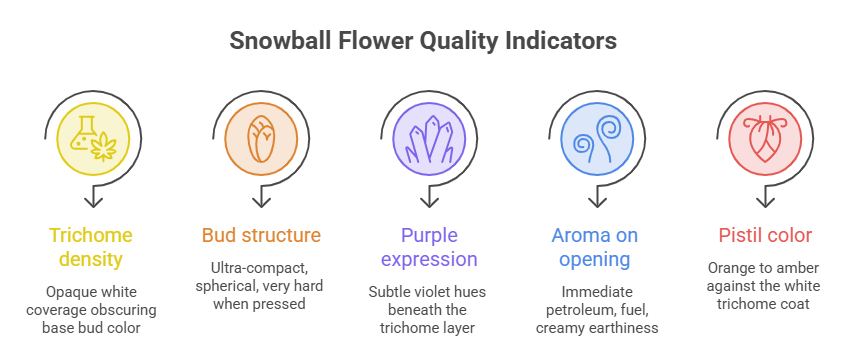
A Visual Checklist for Evaluating Snowball Flower at the Counter
|
Quality Indicator |
What to Look For |
Warning Sign |
|
Trichome density |
Opaque white coverage obscuring base bud color |
Clearly visible green through sparse frost |
|
Bud structure |
Ultra-compact, spherical, very hard when pressed |
Loose or airy structure |
|
Purple expression |
Subtle violet hues beneath the trichome layer |
Absent in some batches, present in cooler grows |
|
Aroma on opening |
Immediate petroleum, fuel, creamy earthiness |
Flat, primarily earthy without diesel character |
|
Pistil color |
Orange to amber against the white trichome coat |
Brown or oxidized pistils signal age |
Running through this checklist before you commit to a jar takes less than two minutes and gives you a reliable read on whether the batch in front of you represents the cultivar at its potential.
Why Batch Date Is Important for This Cultivar Than for Most
The volatile terpenes from the Chem 4 OG side of this cross begin degrading meaningfully after 60 to 90 days even in properly sealed storage.
A fresh batch and a three-month-old batch of the Snowball strain can look nearly identical through the glass, since the trichome structure persists even as the aromatic compounds inside those trichomes break down.
- Ask your budtender about the harvest or package date before you buy.
- Any batch over 60 days old in storage should be priced accordingly.
- A deep discount on Snowball can sometimes indicate a batch approaching terpene decline rather than generosity in pricing.
You can check our current deals page to see what we currently have running, including our Flower Friday discount, where all flowers are 15% off every week.
How to Use Your Budtender as a Quality Filter
At Hamilton’s, our budtenders know batch details because we source locally from Oklahoma cultivators and evaluate freshness before anything reaches the shelf.
The most useful question you can ask is not what the THC percentage is. It is what the total terpene percentage reads on the current batch COA and how long ago the product was harvested.
A total terpene percentage above 2% on this cultivar typically signals a fresher, better-handled batch. Anything below 1.5% is worth a conversation about whether a fresher option exists.
Final Takeaway
The Snowball strain rewards patients who know what they are looking for at the counter. Trichome opacity, petroleum-forward aroma, compact bud structure, and batch freshness all tell you more about what you are taking home than the strain name alone.
At Hamilton’s Bud and Bloom, we source and evaluate with exactly these standards in mind. Visit our dispensary to see what we currently have in stock, and let our budtenders walk you through the freshest available batch.
Why do some Snowball batches look purple while others do not?
Purple expression requires cooler nighttime temperatures during late flowering. It is not a quality indicator on its own, just a reflection of the grower’s environmental management during the final weeks.
How hard should Snowball buds feel when pressed?
Very firm. The dense, spherical structure from this cultivar’s genetics produces buds that feel almost solid. A loose or spongy texture suggests either an early harvest or poor curing conditions.
Can I use a Snowball flower for solventless extraction at home?
Yes, its capitate-stalked trichome structure makes it one of the more effective cultivars for basic ice water separation, though results depend heavily on the freshness and density of your specific batch.
What is the difference between caryophyllene and myrcene in this cultivar's profile?
Caryophyllene contributes the peppery, fuel-adjacent character and engages CB2 receptors directly. Myrcene provides the earthy, musky base note and enhances cannabinoid absorption through the blood-brain barrier.
Should I ask for the COA before buying a Snowball flower?
Yes, and specifically ask about the total terpene percentage, not just THC. A terpene reading above 2% typically indicates a fresher batch with better-preserved aroma and effect profile.