
If you have been researching the Super Lemon Haze strain as your next grow, you have probably seen the same facts repeated everywhere: 9 to 10 weeks of flowering, high yields, moderate difficulty.
All accurate, but none of it tells you what growing this cultivar feels like week by week or where the specific traps are that trip up growers who relied on that surface-level information.
At Hamilton’s Bud and Bloom, we work closely with Oklahoma cultivators who grow this strain, and what they describe is a more demanding and more rewarding process than most guides suggest.
The Flowering Stretch That Catches Indoor Growers Off Guard
The single most underestimated challenge with this cultivar is what happens in the first two to three weeks after you flip to a 12/12 light cycle.
Most growing guides mention that Super Lemon Haze stretches. What they do not tell you is that the plant can effectively double its height during this window, since its 80% sativa genetics continue pushing vertical growth long after flowering begins.
If you flip at 18 inches without accounting for this stretch, you can end up with plants pressing against your lights before your buds have developed properly. Experienced growers recommend flipping when plants are no taller than 12 to 14 inches indoors, specifically to leave room for this pre-flower extension without losing light distance.
Why Training Before the Flip Matters More Than After
Topping early in the vegetative stage encourages multiple main colas rather than one central stalk, which distributes that vertical energy across a wider canopy during the stretch.
A ScrOG net set up before the flip is the most practical way to manage height while maximizing the light coverage each bud site receives. Training after the flip becomes progressively harder as the plant locks into its structure.
Understanding Why Super Lemon Haze Strain Is Specifically Vulnerable to Nutrient Burn
Most growing content lists Super Lemon Haze as a heavy feeder and leaves it at that. Leafly’s grow guide notes the opposite concern: this cultivar is vulnerable to nutrient burn despite its size. The reason connects directly to its structure.
Sativa-dominant plants like this one tend to have lower overall leaf density compared to indica-heavy cultivars. Less leaf mass means less surface area to absorb and buffer excess nutrients before they affect the plant. A dense indica can tolerate nutrient excess more gracefully because it has more tissue to distribute that load.
Super Lemon Haze does not have that buffer, so feeding at the same rate you would use for a bushier plant regularly leads to tip burn and leaf curl in the mid-flowering stage.
- Keep nitrogen levels conservative during early flowering rather than continuing the aggressive vegetative feeding schedule.
- Switch to a phosphorus- and potassium-forward nutrient mix at week three of flowering to support bud development.
- Increase nutrient concentration only in the final two weeks before harvest, then flush thoroughly before cutting.
What the Flowering Timeline Looks Like Week by Week
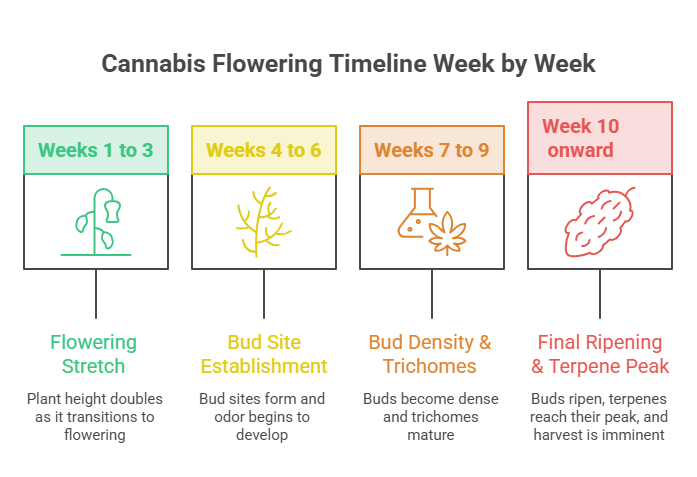
|
Week Range |
What Is Happening |
Key Action |
|
Weeks 1 to 3 |
Flowering stretch, height doubles |
Monitor height daily, train aggressively |
|
Weeks 4 to 6 |
Bud sites establishing, odor builds |
Dial back nitrogen, maintain humidity at 45 to 50% |
|
Weeks 7 to 9 |
Bud density and trichome development |
Watch trichomes shift from clear to milky |
|
Week 10 onward |
Final ripening, terpene peak |
Assess amber trichome ratio before harvest |
Most sources cite 9 to 10 weeks. Outdoor grows in warm climates like Oklahoma can push closer to the 10-to-11-week range before trichomes reach their peak.
Why Harvest Timing Directly Affects What the Strain Tastes Like
Limonene, the terpene responsible for the sharp citrus brightness that defines the Super Lemon Haze strain, is one of the more volatile compounds in the terpene spectrum.
It peaks during the final week or two of proper ripening and begins degrading quickly once the plant is cut. A harvest even a few days early can strip significant lemon intensity from the final product.
Checking trichomes under magnification and waiting until roughly 15 to 20% of heads have shifted to amber gives you the full limonene expression alongside the THC maturity that makes the experience worth the 10-week wait.
Why Store-Bought Cannabis Is Often Better Than What You Grow
This is the honest conversation most grow guides avoid. A properly grown, cured, and handled batch of the Super Lemon Haze strain requires controlled temperature, humidity management, a 10- to 14-day slow dry, and weeks of curing to preserve the terpene character that makes it distinctive.
Oklahoma-licensed cultivators doing this at scale have dedicated rooms, precision equipment, and years of experience with this specific gene.
If you want to experience what a well-executed batch tastes and feels like before committing to a grow, the Super Lemon Haze 1g Pre-Roll by Rockstars gives you that benchmark.
For something portable that locks terpene quality in at production, the Super Lemon Haze 2g Disposable by Cure Injoy is worth comparing directly against your own harvest.
Final Perspective
Growing the Super Lemon Haze strain rewards patience and technical attention more than most beginner guides acknowledge. Managing the flowering stretch, respecting its nutrient sensitivity, and waiting for the right trichome window all separate a mediocre harvest from an exceptional one.
If you want to taste what this cultivar can be at its best while your own grow develops, visit Hamilton’s Bud and Bloom to see what our Oklahoma cultivators are currently producing.
How tall can Super Lemon Haze get indoors?
Without training, indoor plants can reach 70 to 90 inches after the flowering stretch. Most growers flip early and use ScrOG nets to keep height manageable.
Why does my Super Lemon Haze smell weaker than expected at harvest?
Cutting before trichomes fully mature reduces limonene expression, since that terpene peaks in the final ripening window and degrades quickly after harvest.
Does this strain need a specific humidity range during flowering?
Keeping humidity between 45 and 50% during mid-flower helps prevent mold in the dense upper colas while preserving terpene development in the outer bud sites.
Can I grow Super Lemon Haze outdoors in Oklahoma?
Yes, Oklahoma’s warm summers support this strain well. Plan for a late October harvest and ensure you have enough outdoor space for the plant’s significant height.
How do I know when to harvest without a microscope?
The pistils shift from white to orange, and the buds stop visibly swelling. A loupe or jeweler’s magnifier gives you the most accurate trichome read if you want precision.